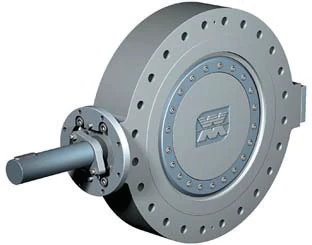
Cavitation control in a butterfly control valve
Cavitation can limit the use of a butterfly valve for control duty. This publication describes components that distribute the pressure drop and affect flow during the critical partially open stage.
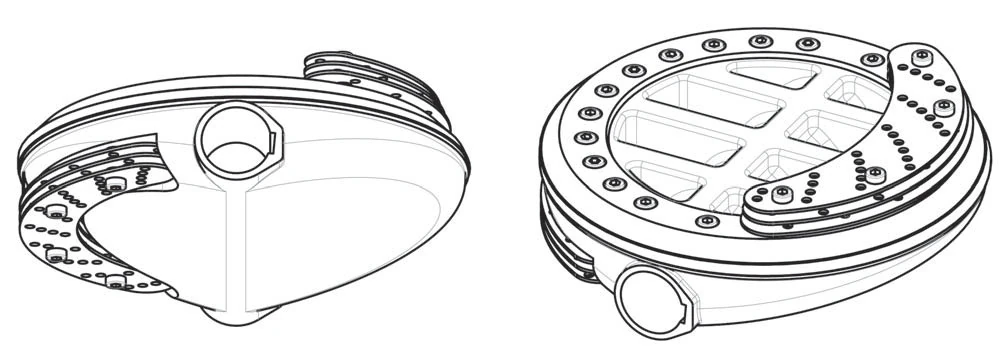
Perforated components alongside the disc
The deflectors described are attached to the disc and contain openings through which the medium passes at small valve openings. Distributing resistance across those passages affects local velocities and pressures. The components sit on both sides of the disc, with illustrations showing their shape and simulated flow. The aim is to limit conditions that encourage cavitation and noise.
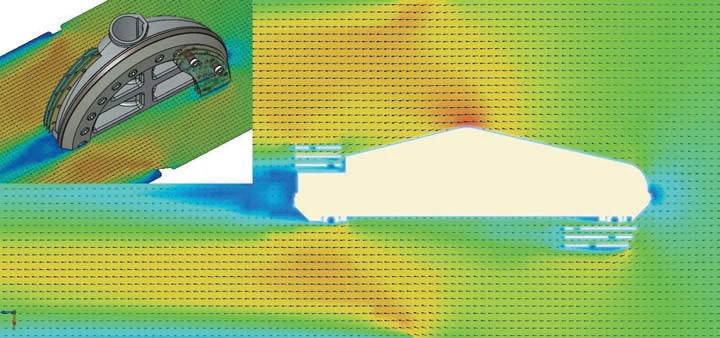
What happens at full opening
At full opening the components align with the flow, reducing obstruction compared with the throttling position. The stated control range for the design is approximately 1:10, compared with 1:3–1:5 for the standard arrangement considered. These values concern the compared designs and do not replace the characteristic of an individual valve.
Very small flow: an additional path
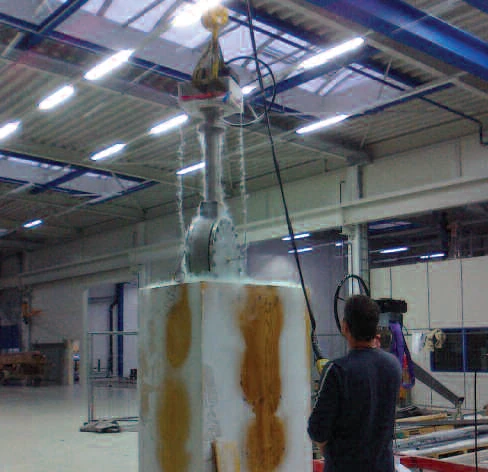
For small flows, a QUADAX butterfly valve is combined with a COAX-LT valve. The example gives a Kv coefficient range of 0.4 to 40 m³/h. Kv here is not the installation’s actual instantaneous flow. In the tank-filling sequence described, the small valve handles the initial stage, the butterfly valve the larger flow, and the final stage is again controlled more gently.